Total Pageviews

Friday, 11 May 2018

Journal 1- Pedagogy of Online Learning


Objective:

Faculty resistance to engage in online education can be found across varying levels of education universally.  With a growing tech savvy population not only in North America, but globally, it is imperative now more so than ever to recognize these resistances in order better help address the future of online education.  

Reflective:

I have been very fortunate with my experiences as a student with online learning.  With that said I still have yet to be on the other side of the fence and be an online educator.  As of now I primarily teach face to face in a clinical setting at a dental hygiene college.  Reflecting back to my own experiences with this topic, I do recall having a recent conversion with the program coordinator about the possibility of offering some dental hygiene courses online or even looking into developing online courses for a degree component.  I recognize that this does require years of preparation to execute correctly. The initial reaction to this conversation was defiantly concerns about time, costs, and resources. Simply put the initial conversation was more along the lines of that they did not want to deal with this possible expansion of the program as it will be a lot of work.  I believe this resistance can be common for many different programs that have become comfortable in the ways they are conducted.  The idea of developing or transitioning to something different or new can be daunting to those that are perhaps set in their ways of teaching or even unwilling to adapt new formats of delivery even if it could benefit them in the long term.

Interpretive:

Upon research I found several articles expanding on ideas that could help address ways to reduce the resistance of engaging in online education.  Sibley and Whitaker (2015) discuss the importance of institutional support systems to ease this transition through elements of incentives and providing the appropriate training by stating “Faculty must have evidence of efficacy, access to easy points of entry, confidence in institutional support, and incentives to develop online instructional capacity” (Sibley and Whitaker, 2015).  They suggest several potential incentives that can be utilized by institutions to help engage  or entice resistance faculty into participating online learning including:  
  • Providing compensation as salary, research funds, or time (e.g., a course buy-out)
  • Appealing to a sense of curiosity and a desire to develop new skills for those attracted to experimental work or invigorated by the chance to reimagine their courses
  • Delivering training and support to lower the barriers and to decrease the time and effort needed to develop or adapt new instructional approaches
  • Activating a sense of mission and loyalty to their students and the institution
  • Increasing a sense of relevance for those who want to remain current in the rapidly changing environment of higher education
  • Recognizing effective engagement in online learning in the institutional reward systems (Sibley and Whitaker, 2015)
After reviewing these ideas about the potential of incentives, I could see the college I teach at adapting some of these if not all approaches in the future to help ensure faculty participation in online learning. 

Decisional:

After reading Sibley and Whitaker’s (2015) article, I feel more confident in the future of engaging resistance faulty member into at least considering the option of teaching a course online given that they are provided with the appropriate support and resources.  Like any change there needs to be a willingness to be vulnerable to what we do not know and to be open to what could be learned.  For the institution in which I teach at, there are several didactic courses that could be transitioned into online courses.  I feel that even starting with one course would be a start. I feel that I can approach the idea of this more confidently now to my superiors.

References:

Sibley and Whitaker (2015). Engaging Faculty in Online Education. Retrieved from:
https://er.educause.edu/articles/2015/3/engaging-faculty-in-online-education


Engaging Faculty in Online Education

https://er.educause.edu/articles/2015/3/engaging-faculty-in-online-education

Key Takeaways

  • By drawing on direct experience, facilitating learning from peers, and exploring engagement practices, Brown University's online development team is creating an online learning "adoption wave" among faculty.
  • The online development team continues to introduce ways of helping faculty and senior administrators more fully understand and expand on the opportunities online learning presents.
  • An institution steeped in the traditions of residential education and initially dubious of online education now builds on its early success with online learning.
Karen Sibley, Vice President of Strategic Initiatives and Dean, School of Professional Studies, and Ren Whitaker, Director of Online Development, School of Professional Studies, Brown University
The initial resistance to online learning by many institutional leaders has given way to urgency about engaging faculty in online instruction. Even at traditional residential universities and colleges with well-established excellence in seminar, lecture, and lab instruction, experimentation with online learning is rampant as institutions rush to adopt educational technology and online pedagogy. Administrators may urge action, and some faculty view exploring online teaching and learning as an inviting and even invigorating challenge, but others still decline to participate. Many faculty have yet to use technology in their instruction — even something as basic as the campus learning management system — much less experiment with flipped or hybrid classes. This leaves many IT, ed tech, and online learning professionals challenged to move their institutions and faculty online and into the 21st century of education.
Because mandates rarely succeed in the higher education culture, finding ways to ease the pedagogical transition for inexperienced, curious, and even reluctant faculty members is critical. Those professionals charged with introducing and implementing online education must give faculty the opportunity to better understand, explore, experience, critique, and ultimately accept or reject this form of pedagogy.

Institutional Support: Incentives

With knowledge of the salient research evidence and familiarity with the concepts of online learning, faculty members can understand its value to students. Asynchronous online learning provides students more time and flexibility for class participation, and it enables reflection and thoughtful engagement while allowing students to meet personal and professional obligations. Well-designed and executed online courses can provide an engaging, resource-rich learning environment in which students share their ideas, research, and knowledge with others in a collaborative peer-to-peer learning experience. Students have the opportunity to develop an expanded network of peers, faculty, and experts that brings new information and fresh perspectives to the experience, enhancing the outcomes for both students and faculty.
In contrast to the benefits for students, the advantages for faculty faced with creating and teaching online courses might not be obvious. The time and effort required to use new technology, to plan and develop a course, to work with instructional designers who have little or no knowledge of the academic discipline, and to teach in "new ways" may seem a daunting task and a drain on their time with little potential for reward. Faculty might believe that this time would be better spent in research, writing, and other professional activities that garner higher recognition and reward than teaching.
Institutional leaders can communicate clearly the value added by technology-assisted learning at their institution and how online learning can enhance the student experience, but they need to provide incentives and support to secure faculty participation. Although assessing and reporting institutional benefits and success from online instruction are necessary, they are not always sufficient to influence faculty. Faculty must have evidence of efficacy, access to easy points of entry, confidence in institutional support, and incentives to develop online instructional capacity.
Incentives for faculty to develop knowledge and skills in online learning can include:
  • Providing compensation as salary, research funds, or time (e.g., a course buy-out)
  • Appealing to a sense of curiosity and a desire to develop new skills for those attracted to experimental work or invigorated by the chance to reimagine their courses
  • Delivering training and support to lower the barriers and to decrease the time and effort needed to develop or adapt new instructional approaches
  • Activating a sense of mission and loyalty to their students and the institution
  • Increasing a sense of relevance for those who want to remain current in the rapidly changing environment of higher education
  • Recognizing effective engagement in online learning in the institutional reward systems

Inform and Inspire: Ed Tech and Instructional Design Teams

While early experiments with online learning aimed to enhance brand identity, address the need to remain current, and pursue new revenue sources, technology-mediated instruction has become part of the higher education landscape. Some who witnessed the early days of online education or saw poorly designed online courses might still judge online learning with these outdated or low-quality examples in mind. They may think that online learning consists only of lecture-capture videos and PowerPoint presentations viewed by students at their leisure, followed by online quizzes to test understanding.
"MOOC mania" did much to promote the idea of online learning, but the media's focus on huge enrollments raised criticism of low completion rates — often not an accurate measure of a MOOC's success. Questions about the lack of rigor or low student engagement emerged in qualitative assessments of online instruction, while dreams of lower costs and broader access held quantitative allure.
Those who recognize online education as a specialized discipline that requires time and thoughtful attention believe that some of these initial efforts damaged public perception of online learning by misrepresenting its potential and fostering conclusions that it is of lower quality than traditional classroom learning. Faculty need to recognize it as a distinctly different medium with qualities and advantages of its own.
What can ed tech and online instructional development teams do to clarify what online education is, what it isn't, and what it can be? First, to counteract misperceptions and assumptions, they can provide faculty a more complete, accurate, and realistic picture of what quality design and facilitation look like in online education. By showing faculty examples of well-designed online courses and best practices in online pedagogy, these teams can inspire faculty to experiment with technology-enhanced teaching to produce courses of the highest quality. Next, they should encourage early adopters to share with colleagues their experience working with the design and tech support teams as well as their experience teaching online. This might encourage other faculty to investigate and experiment with online education.

Training and Support

Faculty have expertise in scholarship and in classroom instruction, but for many, online learning remains a new and discomforting area. While faculty rely on technology in their own scholarship, when it comes to teaching, some see technology as standing betweenthem and their students — not as an aid to instruction or a means to connect more effectively with their students. Some feel intimidated or overwhelmed by new learning technologies, or fear that they will appear inept to tech-savvy students or colleagues. Others are offended at "being asked to relearn" how they teach.
Ed tech and online learning professionals can lessen these concerns by listening closely to and working respectfully with faculty to build trust and positive, productive relationships. They should do everything in their power to be seen as a respected, highly skilled, and supportive resource, giving faculty the confidence to ask novice questions or take appropriate risks with their course designs. Mutual trust and respect enable tech and design experts to provide the training and support faculty need.
With time a scarce and valued resource and faculty attention directed to many compelling obligations, online course design and facilitation training must be easy to access and digest. Initial instruction in online pedagogy must focus on the highest-level priorities and skip everything else. Greater understanding and ability can come later, when the faculty member is proficient at the basics and has the confidence and curiosity to further develop their course design and facilitation skills.
Ed tech and online development teams need not reinvent the wheel to develop this kind of training. Many institutions have effective programs, resources, and best practices for online faculty and are happy to share them with colleagues. Borrow before you build whenever possible to save time and effort.
The online development team at Brown University has a highly effective faculty onboarding and development process that is somewhat time intensive initially. To start, an interested (or simply curious) faculty member meets with the director of online development to discuss teaching online, bring up questions and concerns, and explore a course or course concept for possible development.
Next, the faculty member is introduced to the Course Development Process Model(figure 1). The model illustrates the key milestones and deliverables involved in online course development and facilitation, as well as what is required from both the faculty member and the design team at each stage. Clarifying the process and expectations right from the start removes any mystery about the process and prepares faculty for the work ahead. During this conversation some faculty members realize they can't devote the time and effort required to develop a course and make an informed decision not to participate — at least at that time. This step can save everyone involved much frustration, time, and effort.
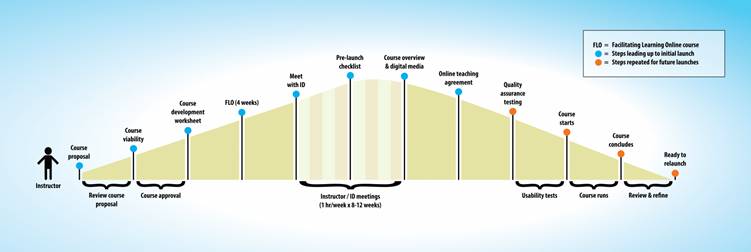
Figure 1. Online course development process, School of Professional Studies, Brown University
Once a faculty member decides to develop an online course, a dedicated instructional designer (ID) is assigned to the project. The ID meets the faculty member on a weekly basis and begins by asking: What excites you about this course? What do your students love about it? By uncovering the instructor's vision and passion for teaching and for the subject matter, the ID can help imbue the course with the instructor's energy and personality and build in points of connection between professor and student.
Whether preparing a new course or redesigning an existing face-to-face course for the online environment, the ID and faculty member discuss the course learning objectives and consider how to accomplish each in the most engaging and effective way. The key questions are: What should students be able to do as a result of this course? What activities or assignments will generate evidence of student understanding and provide the instructor with an effective means of assessment?
If needed, the ID may introduce the course development worksheet (figure 2) to help the faculty member draft or refine learning objectives. This worksheet prompts faculty to consider different and potentially more meaningful ways to engage and assess student learning while taking full advantage of resources available online.
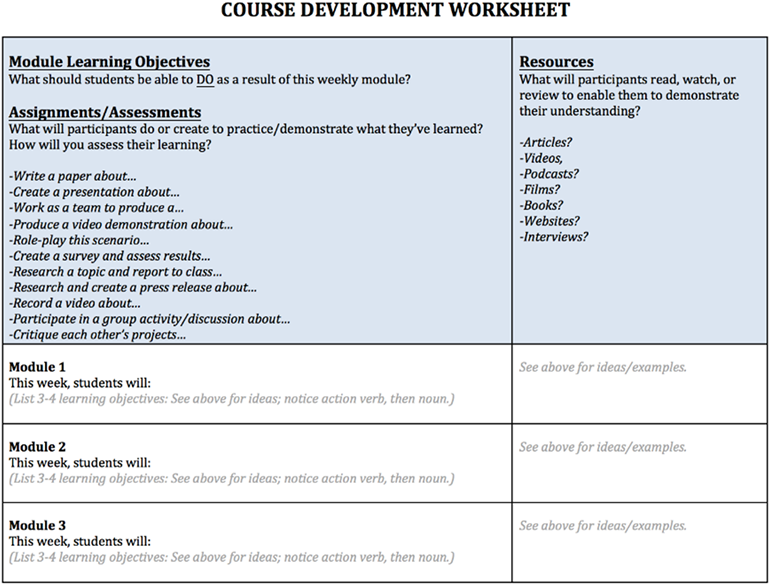
figure 2
Figure 2. Online course development worksheet, School of Professional Studies, Brown University
Prior to the start of their courses, faculty who are new to online teaching participate as students in the four-week, fully online course "FLO: Facilitating Learning Online"(figure 3), to experience online learning first-hand. Each week, they spend approximately one hour in FLO exploring the challenges and opportunities presented by online learning. Faculty also become familiar with Canvas, the LMS in which they will ultimately develop and lead their own courses. FLO is asynchronous; faculty participate as a cohort and must keep up with weekly assignments and discussions. Instructional designers lead the course and are quickly recognized as collaborative leaders and skilled pedagogical guides with expertise in online learning. Perhaps most importantly, faculty have the chance to experiment and ask questions about online learning in a low-risk environment and to build new professional relationships with colleagues across campus through the shared online experience.
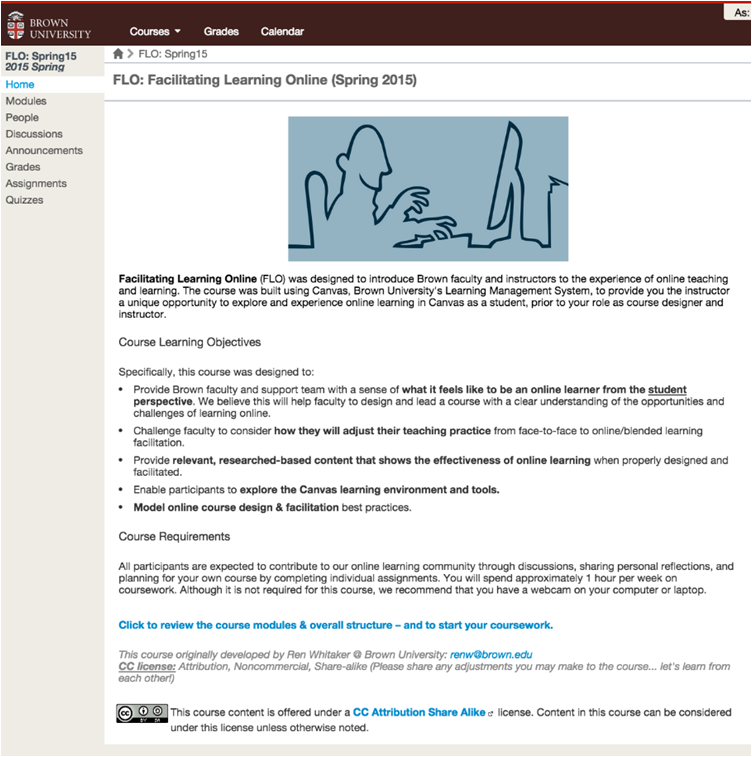
figure 3
Figure 3. Opening screen for FLO: Facilitating Learning Online, School of Professional Studies, Brown University
After faculty have completed FLO and fully developed their courses, they receive the Pre-launch Instructor Checklist from their IDs, conduct a final quality check, and resolve any issues before course launch. The checklist encourages faculty to test course functionality and confirms their readiness to facilitate and assess student work using the LMS. Each checklist item connects to an Online Video Tutorial, so faculty can troubleshoot problems on their own whenever possible rather than depending on ID or IT support. This helps build confidence and empowers the faculty members to take ownership of their courses.
The role of the IT, ed tech, and ID professionals does not end when a course launches. As the course runs, particularly in its first iteration, the IT, ID, and ed tech teams respond quickly to the technological snags and unexpected issues that inevitably arise. This not only supports a positive student experience, but it also ensures that faculty feel supported. Their comfort level encourages them to continue teaching online. Even after the course concludes, asking both faculty and students to share their online experience helps guide improvements to the next iteration of each course.
There is no substitute for positive, authentic, front-line experience with quality online education. Faculty who are well-supported by their institution and online learning specialists become the most effective champions for online learning and can address their peers' concerns. At Brown University, the online learning "adoption wave" started with a few interested faculty members who accepted the challenge of teaching online and flourished with support from the university's online learning professionals.

Recommendations

To meet the expectations of today's students and to serve them well, institutions need to capture the benefits offered by new technology and online instruction and embed best practices in their learning culture. Since faculty participation can neither be mandated nor fabricated, institutions must make online learning attractive, accessible, and valuable to faculty. Their engagement can evolve through a growing appreciation for the educational value of online learning that develops through personal experience — experience best acquired with guidance from knowledgeable and trusted colleagues.
Teams of instructional technology specialists, instructional designers, and education technologists are an important university asset. They work with faculty to overcome resistance to online learning, correct misperceptions, and help faculty create high-quality learning experiences with this important instructional medium. A talented instructional design team provides an effective bridge between the face-to-face instructional platform and a flipped, blended, online, or LMS-supported approach to learning that meets the needs of the increasingly diversified and geographically distributed student populations in higher education.

EDUC 4151 Design & Develop Interactive eLearning Self Directed


  1. Do you currently read any blogs? Why or why not?-Yes I do occasionally refer to blogs but usually it is more for personal gains.  For example I will often come across travel blogs when I am planning a trip.  Or I will often come across food blogs when looking for a particular recipe.
  2. How do you feel about your abilities as a blogger? Do you have any concerns?  I feel that my ability as a blogger has improved over the years.  My skills have been enhanced by many of the Provincial instructor courses as well as through the Online eLearning eCertificate program.
  3. What goal would you like to meet with this blog?  I hope that this blog continues to be a sound resource that I can refer back to when I am developing online courses as well as a place that I can keep adding any new and helpful findings for future endevours of online education. 

Sunday, 6 August 2017

Welcome!


Hello everyone,
My name is Jaspal (Jas) and this is the first online course I'm taking for this certificate in online instruction.  I am from a small town on Vancouver Island (Ucluelet) but have been living in Burnaby for the past 12 years.  I have been a dental hygienist for 9 years now.  I  am a clinical instructor at the Vancouver College of Dental Hygiene.  I have had much of my educational journey through online courses, most recently completing my Masters in Health Studies.   I have always had an interest in online education and am excited to learn more about this world! The following blog has some great resources and reflections on eLearning. 

Journal 3- Summarizing you Learning

Objective:

I have learned a wealth of information about developing an effective online course.  Besides the technical specifications, understanding some of the different theories used in general education such as constructivism, in the classrooms and how it can translate into an online format was enlightening.  Developing an effective online course requires a lot of insight on not only the course content but also considerations for the generations of learners you will be teaching. 

Reflective:

After completing the activities, assignments and reflecting on my own past experiences with online courses, I have developed a greater appreciation for the amount of time it can take to develop and facilitate online courses.  Having only been on the student side thus far, I have mostly resonated with student challenges when it comes to eLearning.  At times I have found with eLearning that life can get in the way and may cause a delay in completing the course work required.  I have found that by having open and good communication with my instructors helpful in overcoming these types of challenges.  This would definitely be something I would want to emulate in the future courses I may teach online one day.

Interpretive:

 After completing the challenges and opportunities of eLearning assignment I have gained more knowledge in what challenges can arise for instructors, as well as how to minimize them.  In addition, I have developed a better sense of the importance following some form of quality guidelines to ensure the course is not only successful and more positive for the learners and students but also effective and efficient.

Decisional:

This course was an excellent start to gain new learning and look back at underlying techniques in which education can be applied to online courses.  I feel that for my online course I would need to research a bit more on approaches best used for healthcare eLearning courses.  I would also like to try and follow approaches that create a supportive and positive learning environment as those types of courses in my past online learning journey have been the most memorable and enjoyable for me. 


Journal 2: Using Quality Guidelines in eLearning

Objective:
With constant growth and fast-paced changing technologies information about almost anything is available to anyone with just a quick “google search.” As a result it important that online courses maintain a standard in which educational institutions, faculty, and students can adhere to.   The importance of developing and following quality guidelines when creating an online course can help ensure success not only for the learners but also make the course enjoyable to teach for the instructor.  If quality guidelines are not used effectively within an online course, the potential of misuse and misunderstandings can occur.  This could potentially result in failed learning experiences and comprehension of critical information.  By developing and following my own checklist or ones recommended by an educational institute I will be better able to meet the needs of my learners.  I feel that this is very important especially in healthcare professions as we are held accountable to provide the most beneficence to our patients in terms of following the best evidenced based practices and research.  The same can be said for when developing quality guidelines in terms of educating learners. 

Reflective:
When reflecting back to my own education, I never really thought about the quality guidelines that institutions or instructors had developed for their courses but understood there was some form of quality control.  My most recent education from Athabasca University was completed all through online courses. I would say my overall experience was successful.  After conducting my own research I found it difficult to find a set checklist of quality guidelines.  However I was able to find that Athabasca University is a full member of many associations that do have recommendations of quality guidelines such as the International Council for Open and Distance Education, Canadian Network for Innovation in Education and the Association of Commonwealth Universities.

Interpretive:
After seeing how Athabasca University chooses to follow quality guidelines I have come to realize that it is not a simple task of just checking off items on a checklist.  Many organizations can be involved if a school decides to incorporate more based on the size and depth of learning taking place. This has been eye-opening for me as I did not realize the amount of work required to not only develop but also continuously reevaluate the guidelines to ensure they are meeting the most current educational needs and requirements of the learners.

Decisional:
This new learning will be applied to my online course by taking the time to appropriately researching and developing a specific set of guidelines.  I would want to know more so if there are specific guidelines for healthcare courses and how they could be incorporated into a potential course that I would develop or teach.  More so, by having a basic understanding of the importance of quality guidelines I can also be better prepared if I start to teach an existing or developed online course.  I would want to ensure that not only the educational institutes’ guidelines were being followed but also be able to implement any changes I would deem beneficial for the overall course.  The examples given by the Canadian Recommended E-learning Guidelines provides a great outline in which I would definitely like to try and incorporate into my own checklists (Barker, 2002). 

References:

Athabasca University (2017). Accreditation. Retrieved from:

Barker, K. (2002). Canadian Recommended E-learning Guidelines (CanREGs). Retrieved


Journal 1: Different Generations of eLearners

Objective:

            Several generations of learners have evolved throughout the years.  Traditionalists were born before 1945.  This generation prefers a more structured form of education.  Members of this generation may also be ideal mentors in the classroom (Panopto, 2017 and Woodward, 2015).  Baby boomers were born between 1946 and 1964.  They prefer a more personally-focused learning structure with elements of participation, reflection, and feedback within the classroom.  Generation X were born between 1965 and 1980.   Learners of this generation are identified one of the most independent of the four groups (Panopto, 2017 and Woodward, 2015).  They prefer more of self-directed approach to education which allows them to learn on their own schedule.   Millennials also known as generation Y were born after 1980.  This generation has grown up with the internet.  Their learning preferences are more personalized on a self-directed schedule (Panopto 2017 and Woodward, 2015).  As a result this generation prefers to have access to information when they see fit through various means of accessibility. Over my journey through online education I have had the opportunity to work with all of these types of learners all different generations all bringing both rewarding challenges and insightful learning experiences.

Reflective:

I fit into the millennials generation of learners and do prefer many of the characteristics that this generation favors when it comes to learning.  Based on this I feel like I’m very self-directed in terms of when, where, and how I chose to pursue my education.  As a learner growing up with the internet, I have developed a strong passion for online education based on the convenience it offers me.  I love the fact that I can work on a course on my own time and reflect accordingly.  Even though this type of education is my preference, many generations may not feel as comfortable but may be forced to pursue some form of online education or training.  For the older generations, I have found that it can be challenging for them to adapt to technology and perhaps ever become frustrated.  With that said I have also found that these generations to be very disciplined and willing to learn or at least try new ways of learning.  As well these generations will always add great insight and perspective to the courses based on a greater depth of experience, whether from work or life in general.   

Interpretive:

Learning more about specific characteristics and preferences that each generation generally has, has defiantly helped me develop a greater appreciation of the importance of being open and accepting of different types of learning.  What may be straightforward to one generation may not be the case for another.  However with that said I believe it is important to not place these generalizations to all generations of learners.  Often they just need to be shown or guided into new technologies and are then able to create and navigate through various types of online media.

Decisional:

I do feel that I have already started to apply this new learning to this course and will continue to apply it when the time comes to develop and facilitate an online course.  For example, I feel that the wiki assignment was a great collaborative learning process of different generations in which I feel like both partners learned a great deal from each other.  I was very impressed by my partner’s efforts in trying to learn how to use a type of social media tool she was unfamiliar with.  As well looking into the future I feel as though I will need to have various methods, resources, and supportive approaches for when I hopefully will teach in a dental hygiene course.  This is mainly because there will most likely be a wide range of generations enrolled that will require different techniques of learning.  Again by being aware of the specific characteristics each generation prefers I feel that I am already taking a proactive approach in helping to reduce the potential challenge eLearners can face.

References:

Panopto (2017). Are You Ready to Support 4 Generations of Learners? Retrieved from: https://www.panopto.com/blog/are-you-ready-to-support-4-generations-of-learners/


Woodward, E. (2015). Meeting the Needs of Four Generations of Learners.  Retrieved from: https://www.trainingindustry.com/content-development/articles/meeting-the-needs-of-four-generations-of-learners.aspx